
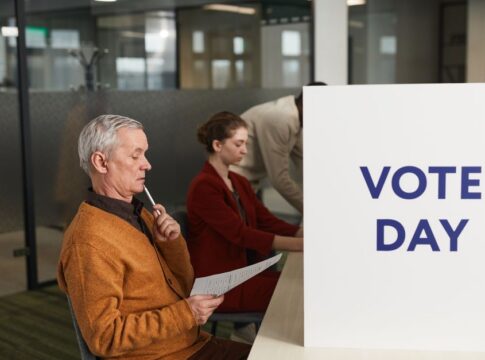
Photo: Edmond Dantès / Pexels
By US Daily Tribune Newsroom, Politics Desk — Published October 26, 2026
Table of Contents
- Key Takeaways
- The Background & Context
- Why This Matters
- Reactions & Analysis
- What Happens Next
- Frequently Asked Questions
With the 2026 midterm elections looming on the horizon, Americans are once again confronted with a familiar question: can we believe what the polls are telling us? Recent surveys suggest Democrats may be positioned for strong performances in upcoming congressional races, yet the scars of polling failures from previous election cycles have left voters, analysts, and campaign strategists wary of taking any forecast at face value. This politics chat polls discussion has become central to how Americans understand their electoral landscape.
The debate over polling reliability isn’t academic. It shapes campaign strategies, influences fundraising, and affects voter enthusiasm. When polls consistently missed the mark in recent presidential and congressional contests, trust in these instruments eroded. Now, as new data emerges pointing toward potential Democratic gains in the 2026 midterms, the question isn’t just what the numbers say—it’s whether those numbers reflect reality or repeat past mistakes.
Understanding the trustworthiness of political polling matters because these surveys don’t merely predict outcomes. They influence them. Polls drive media narratives, shape donor decisions, and can either energize or demoralize voters before they ever cast a ballot. The stakes are particularly high for Congress, where control of even a single chamber can determine the fate of major legislation for years to come.
Key Takeaways
- Recent polling data suggests Democrats may perform strongly in the 2026 midterm elections, though the reliability of such forecasts remains a subject of intense scrutiny and debate.
- The credibility of political polls has been damaged by previous election cycles where surveys failed to accurately predict outcomes, creating widespread skepticism among voters and analysts.
- Questions about long-term political trends in America complicate efforts to forecast electoral outcomes, as shifting demographics and voting patterns challenge traditional polling models.
- Campaign strategies, media coverage, and voter enthusiasm are all influenced by polling data, making the accuracy of these surveys critical to the democratic process.
- The 2026 midterms will serve as a test case for whether polling methodologies have improved enough to restore public confidence in electoral forecasting.
- Odds and forecasts for the upcoming elections vary, reflecting both uncertainty in the political environment and ongoing methodological debates within the polling industry.
The Background & Context
Political polling has been a fixture of American elections for decades. These surveys attempt to capture voter sentiment, predict electoral outcomes, and provide a snapshot of public opinion on candidates and issues. The science behind polling involves sampling techniques, weighting methodologies, and statistical models designed to project how millions of voters will behave based on responses from thousands.
But polling is hard. Really hard.
The industry has faced a credibility crisis in recent election cycles. Surveys that showed comfortable leads evaporated on election night. State-level polls that predicted easy victories turned into nail-biters or outright losses. The reasons are complex: declining response rates, difficulty reaching certain demographic groups, challenges modeling who will actually turn out to vote, and the possibility that some voters simply don’t tell pollsters the truth about their intentions.
Midterm elections present unique challenges for pollsters. Turnout patterns differ dramatically from presidential years. The electorate tends to be older, whiter, and more partisan. Enthusiasm gaps between the parties can shift dramatically based on which party controls the White House. Historically, the president’s party tends to lose seats in Congress during midterms, but that pattern isn’t ironclad, and recent elections have shown voters are capable of surprises.
The question of whether long-term trends in American politics will continue adds another layer of complexity. The country has experienced significant demographic changes, shifts in educational polarization, geographic sorting of voters, and evolving party coalitions. These structural changes can make historical patterns less reliable as predictive tools. What worked for forecasting elections a decade ago may not capture the reality of today’s electorate.
Why This Matters
For ordinary Americans, the reliability of political polls carries real consequences. Inaccurate surveys can create false impressions of inevitability that suppress voter turnout. Why vote if your candidate is certain to win—or certain to lose? This dynamic can become self-fulfilling, where polls don’t just predict outcomes but actually influence them.
Campaign finance represents another critical dimension. Donors make decisions based partly on perceived viability. Candidates who poll poorly may struggle to raise money, even if those polls are flawed. Conversely, candidates buoyed by strong polling numbers may attract resources that help them win—regardless of whether their initial polling advantage was real or illusory.
For Congress, the stakes are enormous. Control of the House or Senate determines which legislation gets hearings, which bills reach the floor, and which priorities receive funding. A Democratic sweep would enable one legislative agenda; Republican control would enable another. Split control would mean gridlock or forced compromise. Voters deserve accurate information to make informed decisions about these consequential choices.
The broader health of democracy depends on trusted information systems. When citizens lose faith in polling data, that skepticism can metastasize into distrust of other institutions—media, election administration, even election results themselves. Restoring confidence in electoral forecasting isn’t just about getting the numbers right; it’s about maintaining faith in the democratic process.
Reactions & Analysis
The polling industry has acknowledged past failures and invested in methodological improvements. Many firms have adjusted their weighting schemes, incorporated education into their models, and experimented with new ways to reach hard-to-survey populations. Some have moved away from traditional telephone surveys toward online panels or mixed-mode approaches that combine multiple contact methods.
Political analysts remain divided on whether these changes are sufficient. Some argue that the fundamental challenges—declining response rates, social desirability bias, turnout modeling—are so severe that traditional polling may never fully recover its predictive power. Others maintain that with proper methodology and transparent communication of uncertainty, polls can still provide valuable insights even if they aren’t perfectly accurate.
Campaign professionals have learned to treat polls as one data point among many rather than gospel truth. Sophisticated operations now combine public polling with their own internal surveys, voter contact data, early voting numbers, and qualitative insights from field organizers. This multi-source approach provides a more textured understanding of the race than any single poll could offer.
Voters themselves have become more sophisticated consumers of polling data. Many now understand concepts like margin of error, sample size, and the difference between registered and likely voter screens. This increased literacy is healthy, though it can also fuel cynicism when polls conflict or when results differ from predictions.
What Happens Next
The 2026 midterm elections will provide a crucial test of whether polling has regained its footing. If surveys accurately forecast outcomes, confidence may begin to rebuild. If they miss badly again, the industry will face renewed questions about its fundamental viability.
Between now and election day, voters should expect a flood of polling data. Some will be high-quality surveys from reputable firms using sound methodology. Others will be partisan polls designed to shape narratives rather than measure reality. Still others will be low-quality surveys that make headlines despite dubious methods. Distinguishing between these categories requires attention to survey details that many news consumers skip.
The question of whether long-term demographic and political trends will continue has no easy answer. America is changing, but the pace and direction of that change remain contested. Immigration patterns, generational replacement, educational attainment, geographic mobility, and cultural shifts all influence the electorate in ways that are difficult to model in real time.
Regardless of what polls currently show, the actual outcome will depend on factors that surveys struggle to capture: candidate quality, campaign execution, late-breaking news events, weather on election day, and the effectiveness of get-out-the-vote operations. These variables can swing close races in ways that no poll can fully anticipate.
Frequently Asked Questions
Why have political polls been unreliable in recent elections?
Polls have struggled due to declining response rates, difficulty reaching certain voter groups, challenges in modeling who will actually vote, and potential reluctance by some voters to share their true preferences with pollsters. These factors can compound to produce surveys that don’t accurately reflect the electorate that ultimately shows up on election day.
What do current polls suggest about the 2026 midterm elections?
Recent polling data indicates potential Democratic strength in the upcoming midterm elections, though the exact magnitude and reliability of this advantage remain subjects of debate. Given past polling errors, analysts caution against treating any current forecast as definitive, and odds and forecasts vary across different models and survey firms.
How should voters interpret political polls?
Voters should view polls as imperfect snapshots of public opinion at a specific moment rather than crystal balls predicting the future. It’s important to look at polling averages rather than individual surveys, pay attention to the margin of error, and remember that polls measure opinion, not certainty. The quality of the polling firm and its methodology matter significantly.
Will long-term political trends in America continue through 2026?
Whether established political trends will persist remains one of the biggest questions facing analysts and forecasters. Demographic changes, shifts in party coalitions, and evolving voter behavior patterns all introduce uncertainty. While some trends appear durable, elections can produce surprises that challenge conventional wisdom about the direction of American politics.
As the 2026 midterms approach, Americans face a familiar tension: the desire for information about likely outcomes versus the knowledge that predictions can fail. The conversation about polling reliability isn’t just technical—it’s about how we understand our democracy and make choices about our future. Whether current surveys prove accurate or miss the mark again, voters would do well to treat them as guides rather than guarantees, and to remember that the only poll that truly matters is the one conducted on election day.