
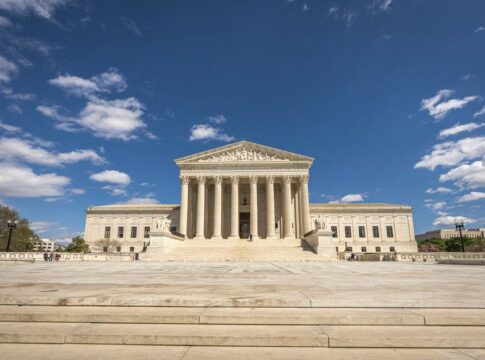
Photo: Mark Stebnicki / Pexels
By US Daily Tribune Newsroom, National Desk — Published September 22, 2026
Table of Contents
- Key Takeaways
- The Background & Context
- Why This Matters
- Reactions & Analysis
- What Happens Next
- Frequently Asked Questions
The Trump administration asks the nation’s highest court to weigh in on a case that sits at the volatile intersection of immigration enforcement, academic freedom, and national security. Multiple reports confirm that federal officials have petitioned the U.S. Supreme Court to review a lower court decision that resulted in the release of a Georgetown University scholar who had been detained by the Department of Homeland Security over alleged pro-Palestinian activism.
The legal battle centers on questions that reach far beyond one individual. Can the federal government detain foreign nationals indefinitely based on their political speech and advocacy? Where does legitimate security concern end and constitutional overreach begin? The case has drawn attention from civil liberties advocates, immigration attorneys, and university communities across the country.
At stake is not merely the fate of one academic but the broader authority of immigration enforcement agencies to act against individuals based on their expressed political views. The Supreme Court’s decision on whether to hear the case—and, if it does, how it rules—could reshape the boundaries of First Amendment protections for non-citizens and the scope of executive power in immigration matters.
Key Takeaways
- The Trump administration has formally requested Supreme Court intervention to reverse a lower court ruling that led to the release of a detained Georgetown scholar.
- The scholar in question was held by the Department of Homeland Security, with his detention reportedly linked to pro-Palestinian political advocacy and speech.
- Lower courts ruled in favor of the scholar’s release, prompting the federal government to escalate the matter to the Supreme Court.
- The case raises fundamental questions about the intersection of immigration enforcement, free speech rights, and executive authority over national security determinations.
- Civil liberties organizations and academic institutions are closely monitoring the case as a potential precedent for how political expression by foreign nationals is treated under U.S. law.
- The Supreme Court has not yet announced whether it will accept the case for review, leaving the legal status of the scholar and similar situations in limbo.
The Background & Context
Immigration detention has long been a flashpoint in American legal and political discourse. The federal government maintains broad authority to detain non-citizens pending removal proceedings or when officials deem them a security risk. But that power is not unlimited. Courts have historically scrutinized cases where detention appears motivated by constitutionally protected activities such as political speech or religious practice.
Georgetown University, one of the nation’s premier institutions for international relations and Middle Eastern studies, has become an unlikely battleground. The scholar at the center of this case was reportedly detained by DHS officials, with his pro-Palestinian advocacy cited as a factor. The exact nature of his statements and activities remains a subject of legal dispute, but the case has galvanized debates about whether expressing support for Palestinian causes—or criticizing Israeli policies—can serve as grounds for immigration enforcement action.
Lower federal courts examined the detention and ruled that it violated constitutional or statutory protections. Those decisions led to the scholar’s release, a development that clearly troubled administration officials. The decision to petition the Supreme Court signals that the executive branch views this case as critical to its broader immigration enforcement strategy and its ability to act swiftly against individuals it perceives as security concerns.
The legal framework governing such cases is complex. Non-citizens do not enjoy all the same constitutional protections as U.S. citizens, but they are not without rights. The First Amendment’s free speech protections, for instance, have been applied to non-citizens in various contexts. Courts must balance the government’s legitimate interest in border security and immigration control against fundamental rights that the Constitution extends to all persons within U.S. jurisdiction.
Why This Matters
For American citizens, this case might seem distant—a dispute over immigration law affecting someone without citizenship. That view would be dangerously shortsighted. The precedents set in immigration cases have a way of bleeding into broader civil liberties jurisprudence. When the government successfully argues that it can detain someone based on their political speech, even if that person lacks full citizenship, it establishes principles that can later be applied more widely.
Academic freedom stands as another casualty. Universities depend on the free exchange of ideas, including controversial and unpopular ones. Foreign scholars, students, and researchers contribute enormously to American higher education and research. If these individuals face detention or deportation based on their political views—particularly on contentious issues like the Israeli-Palestinian conflict—universities become less diverse, less intellectually vibrant, and less attractive to international talent.
The case also illuminates the Trump administration’s approach to immigration enforcement and its willingness to push legal boundaries. By taking this matter to the Supreme Court, officials are seeking not just to detain one individual but to establish a legal principle that would grant them greater latitude in future cases. The implications extend to activists, journalists, and academics from around the world who engage with American institutions.
For Palestinian Americans and supporters of Palestinian rights, the case carries particular weight. Many in these communities report feeling that their political speech is uniquely scrutinized and that advocacy for Palestinian causes triggers law enforcement attention in ways that other foreign policy activism does not. Whether or not such perceptions are accurate, this case will be seen as a test of whether the legal system treats Palestinian advocacy fairly.
Reactions & Analysis
Civil liberties organizations have sounded alarms. Groups like the American Civil Liberties Union and the Center for Constitutional Rights have long argued that immigration enforcement should not be weaponized against political speech. While specific statements about this case were not available in the source materials, these organizations typically argue that allowing detention based on advocacy sets a dangerous precedent that chills free expression.
Within academia, the case has generated concern and debate. Faculty members and university administrators worry about the message sent to international scholars: that their political views could make them targets for detention and removal. Georgetown, as the scholar’s home institution, faces questions about how it will support faculty members caught in such legal battles and what protections it can offer.
Legal analysts note that the Supreme Court’s composition will be crucial. With its current conservative majority, the Court has shown deference to executive branch claims of national security authority in several recent cases. However, the Court has also occasionally surprised observers by protecting individual rights even when national security concerns are invoked. The outcome is far from certain.
Immigration attorneys point out that the case could affect thousands of non-citizens whose immigration status might be jeopardized by their political activities. If the Supreme Court sides with the administration, it could embolden immigration officials to scrutinize social media posts, public statements, and organizational affiliations when making detention and removal decisions.
What Happens Next
The Supreme Court must first decide whether to grant certiorari—legal terminology for agreeing to hear the case. The justices receive thousands of petitions each term and accept only a small fraction. If they decline, the lower court rulings stand, and the scholar remains free. If they accept, oral arguments would likely occur in the coming months, with a decision expected by the end of the Court’s current term.
Should the Court rule in favor of the administration, the scholar could face re-detention and possible deportation. More broadly, such a ruling would give immigration authorities clearer authority to act against non-citizens based on their political speech and associations. Immigration attorneys would need to advise clients more cautiously about public advocacy, and universities might see a chilling effect on campus discourse.
A ruling against the administration would reaffirm limits on detention authority and strengthen protections for political speech by non-citizens. It would not necessarily end the government’s case against the scholar, but it would require officials to demonstrate grounds for detention beyond mere political advocacy.
Regardless of the outcome, the case will likely spawn additional litigation. Other detained individuals will cite the precedent, and advocacy organizations will use the ruling to challenge or defend immigration enforcement practices. The legal landscape around immigration, speech, and executive power will shift, one way or another.
Frequently Asked Questions
Who is the scholar at the center of this case?
The sources identify the individual as a Georgetown University scholar whose detention by the Department of Homeland Security was reportedly connected to pro-Palestinian advocacy. Specific identifying details about the scholar were not provided in the available source materials, though the case has drawn attention from academic and civil liberties communities concerned about the intersection of political speech and immigration enforcement.
What exactly did the lower courts rule?
Lower federal courts ruled in favor of the scholar’s release from DHS detention, decisions that prompted the Trump administration to escalate the matter to the Supreme Court. While the specific legal reasoning of those lower court rulings was not detailed in the source materials, the outcome was clear: judges determined that the detention should not continue, leading to the scholar’s release and the government’s subsequent appeal to the nation’s highest court.
Can the government detain people based on their political views?
This question sits at the heart of the case. While the government has broad authority over immigration enforcement and can detain non-citizens under various circumstances, constitutional protections—including First Amendment free speech rights—apply to all persons within U.S. jurisdiction, not just citizens. Courts must balance national security concerns against fundamental rights, and the outcome of this Supreme Court petition could clarify where those boundaries lie in cases involving political advocacy.
When will the Supreme Court make a decision?
The Supreme Court has not yet announced whether it will accept the case for review. If the justices agree to hear it, oral arguments would likely occur within several months, with a final ruling expected before the end of the Court’s term. If the Court declines to hear the case, the lower court rulings would stand, and the scholar would remain free. The timeline remains uncertain as the Court considers whether the case raises issues significant enough to warrant its attention.
As this legal battle unfolds, Americans are reminded that immigration law is not some distant abstraction. It touches fundamental questions about who we are as a nation, what values we uphold, and how we balance security with liberty. The coming months will reveal whether the Supreme Court sees this case as worthy of its attention—and, if so, where it believes the proper boundaries lie.