
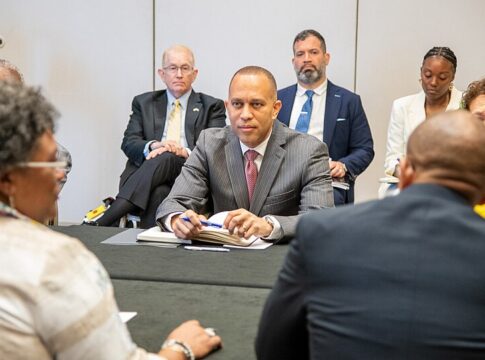
House Democratic Leader Hakeem Jeffries launched an initiative calling for black athletes to boycott Southeastern Conference universities in states that have redrawn congressional districts, describing the redistricting efforts as racially discriminatory tactics requiring an extraordinary response.
Unprecedented Call to Action
During a Capitol Hill press conference, the New York congressman announced support for an NAACP-led boycott targeting SEC institutions in states that recently redrew congressional maps. Jeffries characterized the redistricting as attacks on black political representation, declaring that institutional silence amounts to complicity. The initiative, dubbed Project 42 in honor of baseball pioneer Jackie Robinson, aims to pressure universities into opposing state-level redistricting decisions.
Texas, Missouri, Florida, and Tennessee have already implemented new congressional maps that faced criticism for eliminating districts where minority voters held majorities. Four additional states—Alabama, Georgia, Louisiana, and South Carolina—are expected to pursue similar redistricting following a recent Supreme Court decision that prohibited drawing congressional districts based on racial demographics.
Constitutional Questions Emerge
The boycott call follows a landmark Supreme Court ruling from last month that declared race-based district drawing unconstitutional. States responded by redrawing maps to comply with the decision, prompting accusations that the changes deliberately reduce minority political influence. Jeffries argued that universities bear responsibility to speak against these changes, asserting that moral leadership requires character, courage, and conviction during moments of perceived backlash.
The Democratic leader compared the current moment to pivotal civil rights moments, invoking sports figures Bill Russell, Muhammad Ali, and Jackie Robinson who took controversial stands on racial justice issues. His statement emphasized that achieving progress would require the same level of commitment those athletes demonstrated during their careers.
Political and Athletic Implications
The proposed boycott would affect major college athletic programs across the South, potentially impacting recruiting and revenue for universities that generate millions through sports programs. Jeffries maintained that institutions should feel compelled to address state redistricting decisions because of moral imperatives rather than political pressure. His remarks suggested that athletic boycotts could serve as leverage to influence state legislative decisions on congressional boundaries.
The initiative raises questions about whether college athletes and recruits will respond to calls for boycotts, and whether universities will take positions on state legislative matters. SEC schools have not yet issued formal responses to the boycott proposal, leaving unclear how institutions will navigate pressure to address redistricting while maintaining relationships with state governments that provide significant funding.