
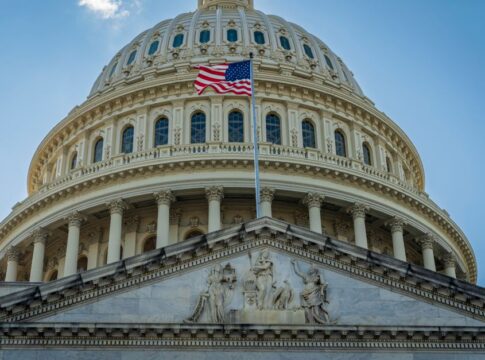
Photo: Mark Stebnicki / Pexels
By US Daily Tribune Newsroom, Politics Desk — Published November 21, 2026
Table of Contents
- Key Takeaways
- The Background & Context
- Why This Matters
- Reactions & Analysis
- What Happens Next
- Frequently Asked Questions
Two influential U.S. senators are pressing the White House to develop a comprehensive strategy to address growing vulnerabilities exposed by artificial intelligence-assisted cyberattacks. The call comes amid mounting concerns that the nation’s critical infrastructure remains dangerously exposed to sophisticated digital threats amplified by rapidly advancing AI capabilities.
Senator Maria Cantwell of Washington and Senator Mike Rounds have renewed their push for urgent action, warning that recent mass outages demonstrate the fragility of systems Americans depend on daily. The senators urge White House officials, particularly the administration’s AI leadership, to close security gaps before adversaries exploit them at scale. This bipartisan appeal reflects deepening anxiety in Congress about whether the United States is adequately prepared for a new generation of cyber warfare.
The timing is critical. As artificial intelligence tools become more accessible and powerful, malicious actors—from nation-states to criminal syndicates—can automate, accelerate, and amplify attacks that once required extensive human expertise. For ordinary Americans, the stakes are personal: power grids, water systems, hospitals, financial networks, and communication infrastructure all face heightened risk.
Key Takeaways
- Senators Maria Cantwell and Mike Rounds are calling on White House AI leadership to develop a comprehensive strategy against AI-enhanced cyberattacks
- Recent mass outages have exposed critical vulnerabilities in U.S. infrastructure that adversaries could exploit using artificial intelligence tools
- The bipartisan appeal highlights growing congressional concern about the nation’s preparedness for AI-assisted cyber warfare
- Lawmakers warn that the United States remains vulnerable as AI technology makes sophisticated attacks more accessible to malicious actors
- The push for action reflects broader debates in Washington about regulating AI while maintaining innovation and national security
- Critical infrastructure including power grids, healthcare systems, and financial networks face heightened risk from automated, AI-driven threats
The Background & Context
The intersection of artificial intelligence and cybersecurity has emerged as one of the defining policy challenges of the decade. While AI promises transformative benefits across industries, it simultaneously arms adversaries with unprecedented capabilities to breach defenses, manipulate systems, and sow chaos.
Traditional cyberattacks required skilled hackers to manually probe systems, identify weaknesses, and craft exploits. That labor-intensive process limited the scale and speed of attacks. Today’s AI-powered tools change the equation entirely. Machine learning algorithms can scan millions of systems simultaneously, identify vulnerabilities in seconds, and generate customized attack code faster than human defenders can respond.
Recent disruptions have underscored these risks. When critical systems fail—whether through deliberate attack or cascading technical failures—the consequences ripple through society. Hospitals lose access to patient records. Banks cannot process transactions. Transportation networks grind to a halt. For elected officials responsible for public safety and national security, these scenarios are no longer theoretical exercises but urgent realities demanding legislative and executive action.
Congress has struggled to keep pace with technological change. Lawmakers face the delicate task of imposing safeguards without stifling innovation or driving AI development overseas. The debate touches on fundamental questions about government’s role in regulating emerging technologies, protecting privacy, and ensuring that America maintains its competitive edge against rivals like China and Russia who are racing to dominate the AI landscape.
Why This Matters
For American families, the threat is not abstract. Consider a scenario where AI-driven attacks simultaneously target regional power grids during a winter storm. Homes lose heat. Refrigerated medications spoil. Emergency services struggle to respond. Now imagine similar coordinated strikes against water treatment plants, financial institutions, or hospital networks. The cascading effects could dwarf any single previous cyber incident.
The economic implications are staggering. U.S. businesses lose billions annually to cybercrime, and those costs are passed to consumers through higher prices and insurance premiums. When critical infrastructure fails, productivity plummets. Supply chains break. Investor confidence erodes. A major AI-assisted attack on financial systems could trigger market panic, wiping out retirement savings and destabilizing the economy.
National security experts worry about adversaries using AI to probe military systems, steal classified research, or manipulate information during elections. Foreign intelligence services could deploy AI bots to spread disinformation at scale, undermining public trust in democratic institutions. The 2024 election cycle has already seen concerns about AI-generated deepfakes and automated influence campaigns designed to confuse voters and suppress turnout.
Perhaps most troubling is the asymmetry. Defending against AI-powered attacks requires constant vigilance, massive investment, and coordination across government agencies and private sector partners. Attackers need only find one vulnerability. They can strike from anywhere, often with little risk of attribution or retaliation. This imbalance favors offense over defense, creating a strategic disadvantage for the United States unless policymakers act decisively.
Reactions & Analysis
Senator Cantwell, who chairs the powerful Senate Commerce Committee, has positioned herself as a leading voice on technology policy. Her warnings about AI cyber vulnerabilities reflect broader concerns among lawmakers who oversee critical infrastructure and national security. By partnering with Senator Rounds, a Republican known for his focus on defense and intelligence matters, Cantwell signals that this issue transcends partisan politics.
The appeal to White House AI leadership puts pressure on the administration to translate rhetoric into action. President Biden has issued executive orders on AI safety and established advisory bodies, but critics argue these measures lack teeth. Without clear standards, enforcement mechanisms, and coordinated strategy across federal agencies, the nation’s defenses remain fragmented and inadequate.
Industry leaders find themselves caught between competing pressures. Tech companies want freedom to innovate and capture market share in the AI gold rush. Yet they also recognize that catastrophic security failures could invite harsh regulation and erode public trust. Some firms have voluntarily adopted safety protocols, but without government mandates, there’s little incentive for universal compliance—especially when competitors cut corners to move faster.
Cybersecurity experts generally support the senators’ call for comprehensive strategy. They emphasize that piecemeal approaches cannot address systemic vulnerabilities. Effective defense requires investment in AI-powered detection systems, workforce training, public-private partnerships, and international cooperation to establish norms and hold bad actors accountable. The challenge is mobilizing political will and resources before a disaster forces reactive rather than proactive measures.
What Happens Next
The senators’ renewed call for action sets the stage for potential legislation in the coming months. Congress could mandate security standards for critical infrastructure operators, increase funding for cybersecurity research, or create new regulatory frameworks specifically addressing AI-related threats. However, any major bills will face the usual gauntlet of committee hearings, negotiations, and political horse-trading that can delay or dilute proposals.
The White House must decide how aggressively to pursue executive action. The administration could issue new directives requiring federal agencies to audit AI vulnerabilities, establish incident response protocols, or partner more closely with private sector operators of critical infrastructure. Such moves would likely face legal challenges and resistance from industry groups wary of compliance costs.
International dimensions complicate the picture. Cyber threats ignore borders, and effective defense requires cooperation with allies while countering adversaries. Diplomatic efforts to establish global AI safety standards have made limited progress, with authoritarian regimes rejecting constraints they view as threats to sovereignty and competitive advantage. The United States must balance domestic security needs with the reality that unilateral action has limited effectiveness against transnational threats.
Public awareness will play a crucial role. Most Americans remain only dimly aware of AI cyber risks until a major incident forces the issue into headlines. Advocates hope that high-profile warnings from senators and other officials will build momentum for preventive action. Yet translating concern into sustained political pressure requires clear communication about complex technical issues—a perennial challenge in policy debates.
Frequently Asked Questions
What specific vulnerabilities are senators concerned about?
While the senators have not detailed every specific vulnerability, their concerns center on how artificial intelligence can be weaponized to attack critical infrastructure including power grids, water systems, healthcare networks, and financial institutions. AI tools enable attackers to automate the discovery of security weaknesses, craft sophisticated exploits, and launch coordinated strikes at speeds that overwhelm traditional defenses. Recent mass outages have demonstrated how fragile these systems can be when targeted or disrupted.
How does AI make cyberattacks more dangerous?
Artificial intelligence amplifies cyber threats in several ways. AI algorithms can scan millions of systems simultaneously to identify vulnerabilities that human hackers might miss. Machine learning tools can generate customized malware that adapts to evade detection. AI-powered bots can conduct social engineering attacks at massive scale, tricking employees into compromising security. Perhaps most concerning, AI enables attackers to automate and accelerate every phase of an attack, reducing the time defenders have to respond and increasing the potential for catastrophic cascading failures across interconnected systems.
What can the White House do to address these risks?
The White House has several tools at its disposal. The administration can issue executive orders establishing security standards for federal agencies and contractors. It can coordinate strategy across departments including Homeland Security, Defense, and Commerce to ensure unified response capabilities. The president can direct increased funding for cybersecurity research and workforce development. Additionally, White House leadership can convene private sector stakeholders to develop voluntary standards and information-sharing protocols. International diplomacy to establish norms around AI use in cyber operations represents another important avenue for presidential action.
Why is this a bipartisan issue?
Cybersecurity threats affect all Americans regardless of political affiliation. When critical infrastructure fails, the consequences impact communities across red and blue states alike. Both parties recognize that national security and economic stability depend on robust defenses against evolving threats. While Democrats and Republicans may disagree on the appropriate balance between regulation and innovation, there is broad consensus that the government has a role in protecting critical systems from foreign adversaries and criminal actors. The partnership between Senators Cantwell and Rounds demonstrates that lawmakers can find common ground on issues where partisan differences matter less than shared national interests.
As artificial intelligence continues its rapid evolution, the race between attackers and defenders intensifies. The senators’ urgent appeal to White House leadership reflects a growing recognition that America cannot afford complacency. Whether their warnings translate into meaningful action will depend on political will, bureaucratic coordination, and public pressure in the months ahead. For now, the vulnerability remains—and the clock is ticking.