
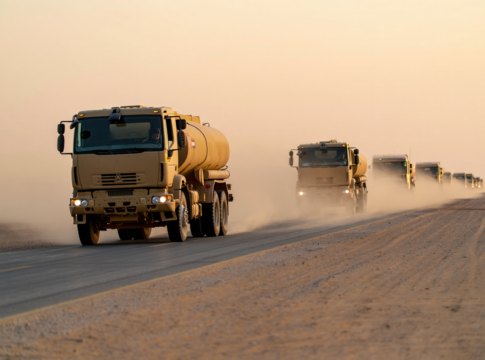
American forces sustained one casualty for every 24 fuel convoys in Afghanistan, with attacks on supply routes killing or wounding an estimated 3,000 U.S. soldiers and contractors between 2003 and 2007. Military experts now identify petroleum dependence as the nation’s greatest battlefield vulnerability.
Strait of Hormuz Crisis Exposes Defense Weakness
Recent conflicts in Iran closed the Strait of Hormuz, cutting off 20% of the world’s oil supply and triggering a 55% jump in oil prices. The U.S. military, the largest single institutional consumer of oil on the planet, faces unprecedented strategic risk. Defense logistics professionals calculate the Fully Burdened Cost of Fuel at up to $1,000 per gallon when shipping to Middle East war zones, accounting for procurement, transport, and protection expenses.
A 2023 U.S. Naval Institute Proceedings article warned that future Pacific conflicts would push fuel logistics to the breaking point, with challenges far exceeding those faced in Iraq and Afghanistan. The entire fuel supply chain, from forward units back to American refineries, remains exposed to attack at every point.
Energy Costs Measured In Blood And Treasure
The military spent an estimated $20.2 billion annually on air conditioning structures in Iraq and Afghanistan alone. Army research at the National Training Center found that simple spray foam insulation cuts climate control costs by 50%. Modern warfare increasingly relies on small, agile teams using robotics and autonomous systems, requiring resilient power sources at the point of need rather than vulnerable convoy routes.
What This Means For National Security
Military planners advocate for an all-inclusive energy strategy combining small-scale nuclear, solar with battery storage, hydrogen, wind, and hybrid generators. Reducing fuel dependence improves force protection by minimizing resupply missions, increases operational flexibility by allowing units to operate independently, and enhances mission endurance. Future unmanned and robotic warfare demands reliable, long-duration power systems that support autonomous capabilities without creating new vulnerabilities. Energy resilience represents a strategic priority the military cannot afford to delay.